Stories of Community Opportunity
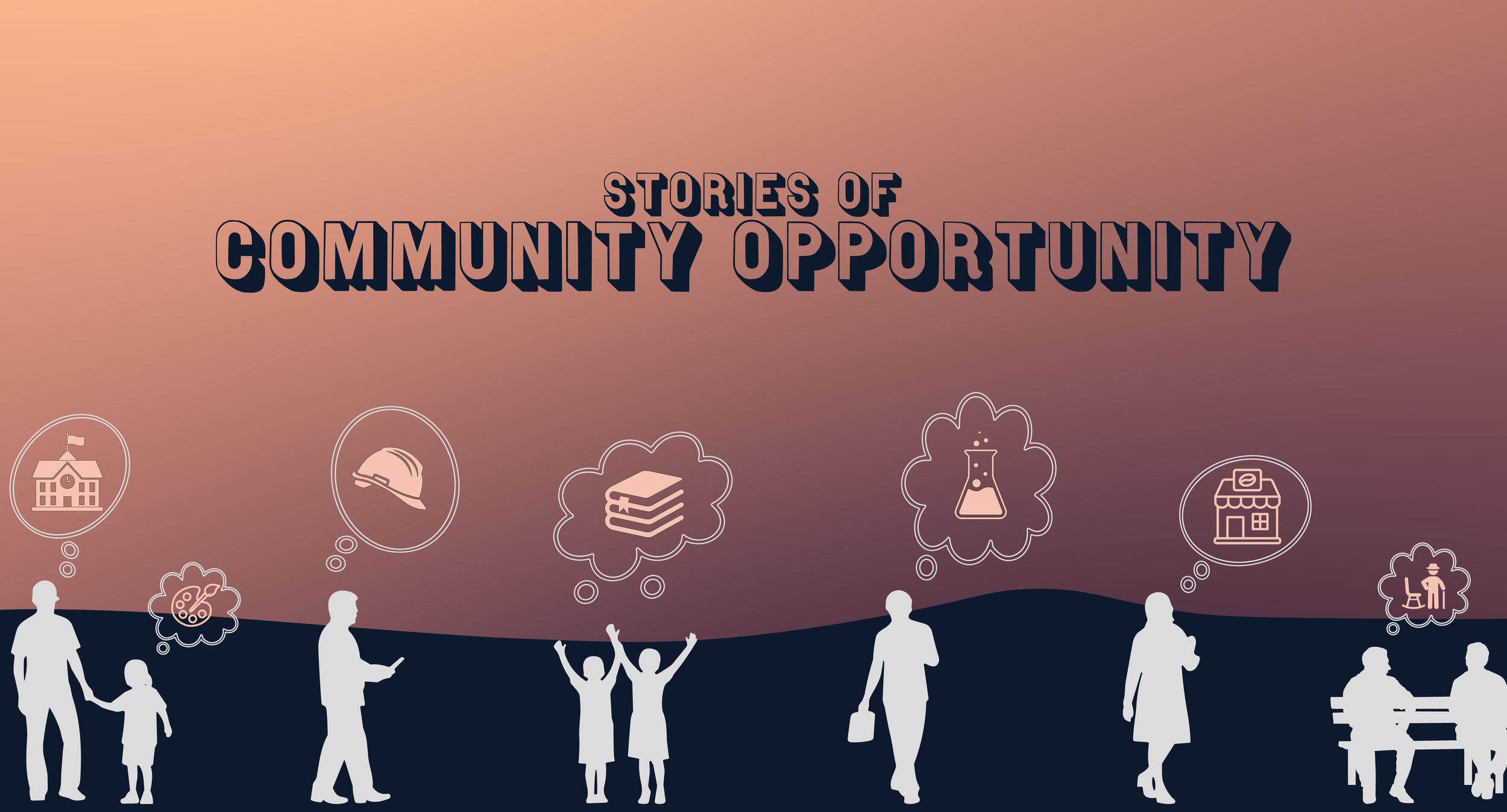
“What is the story of economic opportunity in your community?”
I found myself posing this question to a group of library leaders from across the country at an Urban Libraries Council event. It has been on my mind as I work with various places across the country, including my home of DC. I asked it as I was making the case that their institutions are not only a part of education and human services systems in their cities, but also the economic ecosystem.
Economic opportunity and mobility
Yet as I took a step back to ask this question with a different group, I realized I never really answered it for myself. In trying to do so, I realized that there are differences between community opportunity and individual opportunity. Individual opportunity, especially for younger people, often tracks educational opportunity and is more geographically broad, encompassing areas outside of a single neighborhood or city or state or even a country. This is the case for me. My opportunity came through a great education that afforded me the chance to locate in a place that offered a unique blend of opportunities for my interests and skills.
This aligns with the research of Raj Chetty and others on economic mobility, which has shown how strongly children’s long-term outcomes are shaped by where they grow up and whether they are able to move to higher-opportunity places. That research, including analyses of the federal Moving to Opportunity program, has reinforced the idea that individual opportunity, especially for children, is often tied to geographic mobility.
More recent research has broadened that picture by showing how opportunity is also deeply rooted in place. This form of community opportunity is geographically fixed. While places cannot move like people do, they can prosper or decline. And prosperity is often tied to the story of opportunity. Big cities like New York, the San Francisco Bay Area, Boston, and DC have long carried powerful international narratives about opportunity for both residents and newcomers. For many years, that powered unique growth. More recently, the story has changed as the value of that economic opportunity has run up against very real challenges around quality and cost of living that has pushed growth and vibrancy to places like Austin, Nashville, and the Research Triangle in North Carolina.
This question about a community’s story of opportunity first arose in my work with Richmond and Petersburg, Virginia, where I have supported a diverse coalition called the Alliance for Building Better Medicine that is seeking to improve and onshore manufacturing of pharmaceuticals. Part of their work includes revitalizing a long-closed manufacturing complex in Petersburg. Through work with local stakeholders, we heard that many residents saw the story of opportunity in that community as one related to the local Army base, Fort Lee (formerly Fort Gregg-Adams). Most of those opportunities were limited to either military careers or contracting opportunities at the base.
Even though pharmaceuticals had been manufactured in Petersburg for many years, once the plant closed, it was no longer a part of what residents saw as opportunities for them. Part of the work of the Alliance is to collaborate with community institutions to ensure that residents of all ages are aware of the pharmaceutical-related opportunities that are available and will be created in the future. If they can inspire an adult to pursue specialized training to become a manufacturing technician or a young person to explore the sciences with aspirations toward a PhD, then they will have succeeded.
The future can be defined by perception
To bring it back to the key question, I think the story of a community’s opportunity is only partially about data and analysis. It is also about the collective understandings and perceptions of its residents. In economics and social systems, this idea is often described as reflexivity, a concept popularized by George Soros, which holds that people’s perceptions and beliefs actively shape outcomes rather than simply reflecting reality. It’s a bit like inflation, which itself is influenced not only by actual price changes but also by people’s expectations of future prices.
These narratives cannot make a place thrive on their own. Broad opportunity depends on investments, institutions, policies, macroeconomic trends, and tastes. But it is hard to find a thriving place that doesn’t have a shared understanding of opportunity. Growing up in the booming Las Vegas of the 1990s, I absorbed a clear narrative about how I was in the fastest-growing city in the country, powered by a hospitality industry that was expanding beyond gaming into entertainment, food, and shopping. That story inspired some of my classmates to attend hospitality school, others to pursue legal careers tied to all the new residents and businesses, and still others to skip college to earn a six-figure income as a valet parker. It inspired me to get out of town.
Seeing community narrative as both an important tool and something that is dynamic can help empower residents and power flywheels of opportunity. I think of Pittsburgh a generation ago as it pivoted from steel to robotics. A more recent and ongoing example (or test case) may be Detroit as its story moves from legacy automobile manufacturing to the next generation of mobility and entrepreneurship. DC is in the midst of its own narrative reset, which I may delve into more in the future.
I love the work I do on economic plans, policies, ecosystems, and coalitions. But I have also realized that shaping a community’s future requires making opportunity visible and accessible through the stories that communities tell. People need to be able to see how their lives might directly or indirectly connect to what is emerging around them, whether that means a new industry, a changing downtown, or a shifting labor market. For those of us working in economic development, this creates a responsibility not just to design good systems, but to help translate them into narratives that people can understand, trust, and act on.
I’ll end with that question that I have been meditating on for you to think about from your vantage point:
What is the story of economic opportunity in your community?